
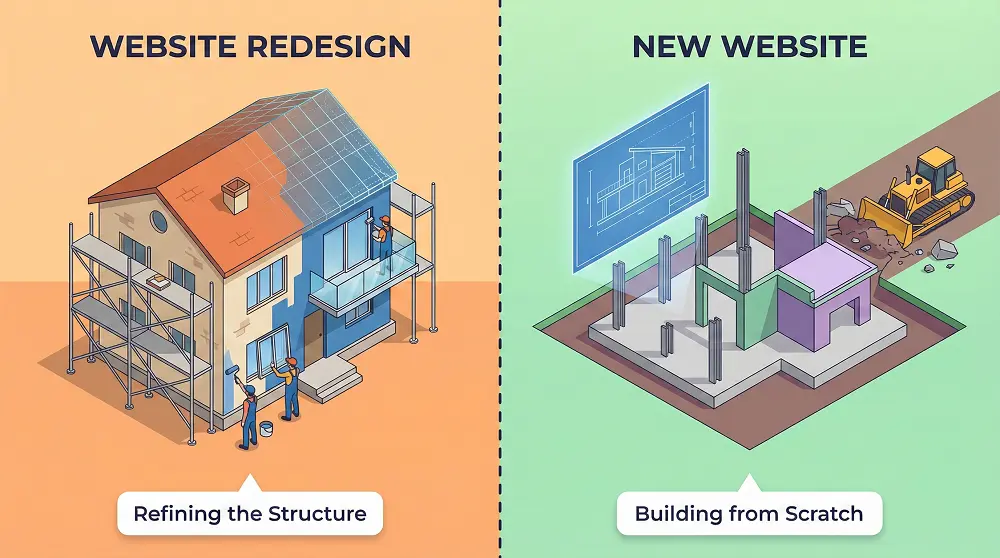
If your site has a solid structure and SEO but needs a fresh look and improved functionality, a website redesign is the best choice. If your site is outdated, slow, or limiting growth, building a new website from scratch will give you a modern, scalable foundation for long-term success.
Studies show that 75% of users judge a company’s credibility by its website design. A clean, modern, and user-friendly site builds instant trust, while an outdated or confusing one can quickly drive potential customers away.
So, should you redesign your website or build a new one from scratch? The right choice can strengthen your SEO, improve user experience, and support long-term business growth.
You simply need to make the right decision , and this guide covers everything you need to know. We’ll explain what each option means, when to choose one over the other, the costs involved, how it impacts SEO, and the best strategies for growth.
What is a Website Redesign?
A website revamp means improving your existing site without completely rebuilding it. The URLs and core pages stay the same, but you enhance the design, functionality, and performance to make it look better and work more efficiently.
It simply means that new designs come with the better colors and fonts, more easy navigation, fast loading times and a layout that easily fits on the mobile screens. You may even experience some new little changes, like improved contacts forms or set off parts of the service.
Research shows that 88% of online users are less likely to return to a site after a poor experience, and even a 1-second delay in load time can reduce conversions by up to 7%. A strategic revamp helps retain traffic, protect your SEO value, and increase engagement without starting from scratch.
What Does Building a New Website Mean?
Building a new website means creating your site from the ground up with a completely new structure, design, and technology. Unlike a revamp, this process often involves new URLs, updated site architecture, improved backend systems, and a fresh user experience.
It’s ideal when your current website has technical limitations, poor SEO foundations, or outdated functionality that can’t support your business growth. A new website gives you the opportunity to rebuild strategically — optimizing performance, scalability, and conversions from day one.
Studies show that nearly 70% of small business websites lack clear calls-to-action, which directly impacts lead generation and sales. When your current site isn’t built for strategy, performance, or conversions, starting fresh allows you to design every element with growth in mind.
Why This Choice Matters for Your Business
From the trust to the sales, your website has an impression on everything. A research shows that the users just take 50 milliseconds to make a decision about the design and 75% of people judge your reliability only focusing on your homepage.
A bad website has high bounce rates (good if under 40% for most pages, but bad design can push it over 60%), which means that you lose conversions and leads. A new or redesigned website can solve this problem by fixing it with an increase in the engagement, SEO rankings, and brand strength.
It helps you get the leads, grow your business, and reach your goals. If you choose the wrong option, you can lose the traffic and have a pause.
What are The Key Differences Between Website Redesign vs New Website
Website revamping or redesign will improve your overall website, but they are different in outlook. A website redesign changes what is there. A new website replaces everything including the existing features and the design of the pages. A simple table of comparison is shown below:
| Aspect | Website Redesign | New Website |
|---|---|---|
| Structure | Keeping the structure intact (URLs, Architecture) | Builds fresh structure from scratch |
| Design or Branding | Update visuals, UI/UX, mobile changes | New direction, full branding overhaul |
| Web Code | Optimizes existing codebase | Fresh CMS, stack, integration |
| Time | Faster (weeks to months) | Longer (months) |
| Cost | Lower (reuses assets) | Higher (full build + testing) |
| SEO Risk | Low (preserves rankings) | Higher but chance for big gains |
| Best for | Visual refresh, minor fixes | Major changes, outdated tech |
Now this comparison shows a website design saves time if your previous website has a strong base. A new website looks good for a long time.
When to Choose a Website Redesign
If your website was made on a strong base but still needs to be modified, you should choose to redesign it. Some of the signs are as follows:
- Your structure makes sense and is good for SEO.
- Your SEO works efficiently, and you do not want to risk losing it.
- To fit in with modern styles, the brand needs to update its look.
- Small problems, like slow pages, hard to use navigation, or a mobile view that is okay but not great.
- The goals of the business stay the same, they just need to get better at converting.
What are the benefits?
- When your domain authority keeps up, you have got it cheaper and faster.
- While you establish trust and achieve more leads, you do not have to be worried about business difficulty.
- Redesigning a sharp website can increase conversions by 30 to 50 % and lower bounce rates 25% to 45%.
- For the details, by refining the UI/UX to let journeys of users become smoother, you can get a higher involvement rate.
When to Choose Building a New Website
If your website is going down, you should decide to make a new one. You should also note the warning signs like:
- Outdated technology or bad code that makes things less secure and slower.
- Things that do not work, like forms that do not work or no space for e-commerce.
- Big changes in the business, like rebranding, going into new areas and adding services.
- No real mobile optimisation, which is important because mobile devices will account for about 63% of all web traffic in 2025.
- The website is more than five years old and has problems like high bounce rates.
The website has a strong SEO base, advanced features and the capacity to grow. It fixes a big problem for redesigning the website that is impossible with an old CMS, its restrictions.
Key Factors to Consider Before Making a Decision
| Factor | What to Consider |
|---|---|
| Website Performance | Is your site fast, responsive, and free of technical issues? |
| SEO Health | Are your rankings strong, and can they be preserved with a redesign? |
| Site Structure | Can your current architecture support new features or growth? |
| User Experience (UX) | Does your site provide easy navigation, mobile-friendliness, and a modern design? |
| Budget | How much are you willing to invest now versus long-term benefits? |
| Timeline | How quickly do you need improvements or a full relaunch? |
| Business Goals | Does your website support current and future objectives, like lead generation or e-commerce? |
| Impact on Traffic & Conversions | Will changes risk losing existing traffic or improve engagement? |
| Scalability | Can your site grow with your business without major overhauls later? |
Cost Comparison: Website Redesign vs New Website
Prices depend on the size, but here is the summary. Redesigning a website uses the same setup, so it is 30% to 50% cheaper, about $5,000 to $20,000 for small sites. It saves time for developers because the content and structure stay the same.
A new website costs between $15,000 and $50,000 or more because it includes all of the design, coding, content migration, and testing.
In the long run, a new website often repays quicker because it usually does not need to be fixed. If it is done in phases, revamping is good.
| Cost Factor | Website Redesign Estimate | New Website Estimate |
|---|---|---|
| Design | $2K-$8K | $5K-$15K |
| Developement | $3K-$10K | $10K-$30K |
| SEO/Content | $1K-$5K | $3K-$10K |
| Total (Small Biz) | $10K-$25K | $25K-$60K |
Which One Won’t Disturb My Website’s Rankings – Website Redesign or Building New Website
If maintaining your current search rankings is a priority, a website redesign is usually the safer option. Since the URLs, site structure, and core content largely remain the same, search engines continue to recognize and index your pages without major disruptions.
Building a new website, on the other hand, can reset your SEO footprint if URLs change or content is moved, requiring careful planning, redirects, and monitoring to preserve rankings.
FAQs
How do I know if my website needs a redesign or a new build?
If your website structure works but looks outdated or underperforms, a redesign is ideal. If it has technical limitations, poor SEO foundation, or cannot support growth, a new website is the better choice.
Will a website redesign affect my current website traffic?
Minimal impact is expected if the redesign keeps URLs, content, and structure intact. Proper planning ensures search engines continue to recognize your pages.
Will a new website improve user experience more than a redesign?
A new website provides more flexibility to create a fully optimized, modern user experience, while a redesign improves usability within the limits of your current structure.
Which option is better for improving SEO?
A redesign is generally safer for maintaining SEO rankings since URLs and content stay intact. A new website can improve SEO long-term but requires careful planning, redirects, and optimization to avoid losing traffic.