
Your law firm website is live, but leads are still nowhere to be found, sound familiar, right? Maybe you built it without really thinking about who your audience is or what they need.
Or maybe you rushed into design without a clear strategy. Perhaps your domain name isn’t helping clients find you, or you’re not tracking the right metrics, so you have no idea what’s actually working.
If you’d rather see how we build sites for firms like yours, our law firm website design page has the details and links to our work for law firms.
Law Firm Websites in Newark, Jersey City and Across North Jersey
Law firms in Newark and Jersey City face dense local competition in organic search. Custom law firm website design tailored to these North Jersey markets ensures your practice stands out in localized legal searches.
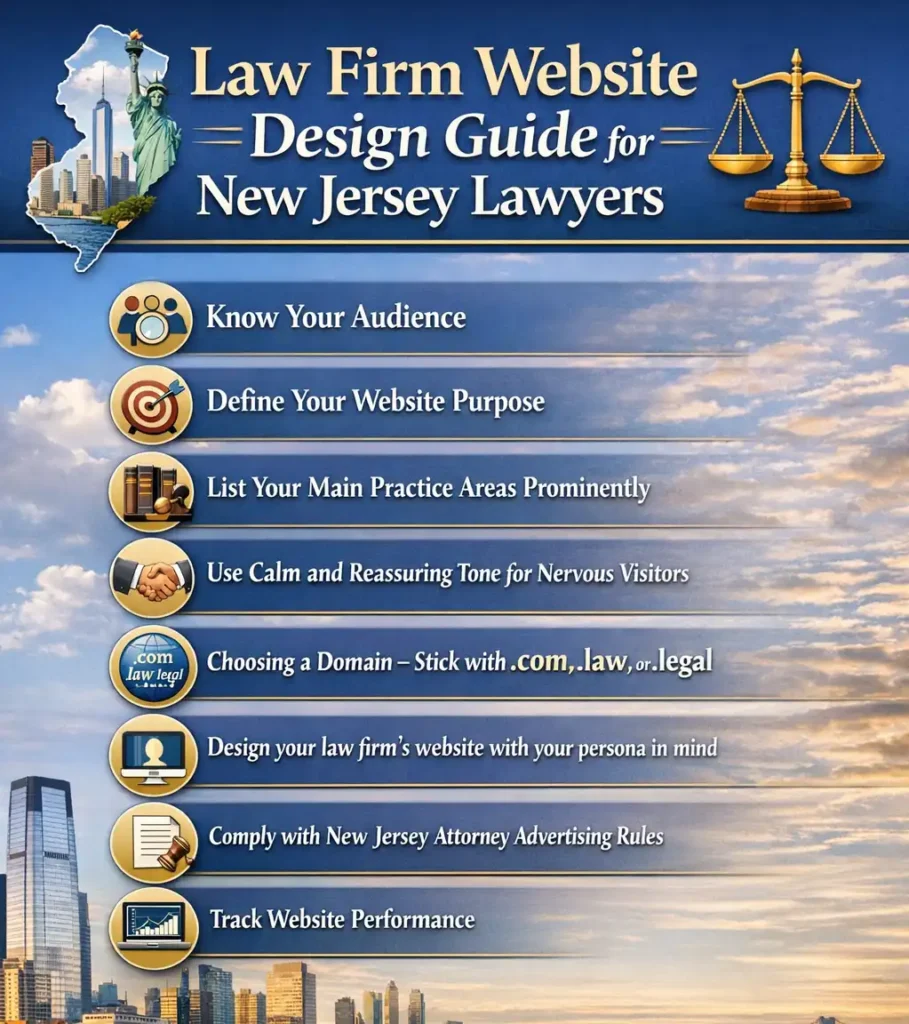
Essential Website Design Factors for New Jersey Law Firms
These are the key factors New Jersey lawyers should keep in mind when designing their website. By focusing on these essentials, your firm can create a professional online presence that builds trust, attracts the right clients, and sets you apart in a highly competitive legal market.
Know Your Audience
Define Your Website Purpose
List Your Main Practice Areas Prominently
Use Calm and Reassuring Tone for Nervous Visitors
Choosing a Domain – Stick with .com, .law, or .legal
Design your law firm’s website with your persona in mind
Comply with New Jersey Attorney Advertising Rules
Track Website Performance
Most law firm websites fail because stressed, anxious visitors can’t quickly figure out if you handle their specific legal issue or whether they can trust you with their case.
1- Know Your Audience First
Who are your ideal clients? Are they accident victims searching for compensation after a car crash? Divorcing spouses trying to protect their children and assets? Business owners dealing with contract disputes or employment issues?
Set your target audience to get better results and try to understand them. Accident victims need immediate reassurance and clear information about personal injury claims. Divorcing spouses want empathy and guidance through an emotional process. Business owners expect professionalism and efficiency.
2- Define Your Website’s Purpose
What do you want your website to actually do? Most law firms need three things: generate qualified leads, educate potential clients about their legal issues, and build trust before the first consultation.
Your website should answer the question “Can this lawyer help me?” within seconds. If visitors can’t figure out whether you handle their specific problem, they move on to the next Google result.
3- List Your Main Practice Areas Prominently
Your homepage should feature your primary practice areas in clear, simple language. Instead of generic labels like “Litigation” or “Civil Law,” use specific terms people actually search for.
For example, “personal injury lawyer Newark,” “divorce attorney Jersey City,” or “criminal defense Camden” or, “personal injury”, “family law”, “employment law”, “estate planning”, “real estate law”, and “business litigation”.
Avoid Latin phrases, acronyms, statutory references, or complex legal terminology on your homepage. Your main navigation should use words like “Car Accidents,” “Divorce & Custody,” or “DWI Defense” instead of “Tort Litigation,” “Matrimonial Law,” or “Municipal Court Representation.”
4 – Use Calm and Reassuring Tone for Nervous Visitors
People searching for lawyers are rarely in a good mental state. They might be frightened about criminal charges, grieving after losing a loved one in an accident, angry about workplace discrimination, or devastated by a spouse asking for divorce. Your website’s tone must acknowledge this emotional reality.
Empathy matters more than impressing visitors with legal expertise. Instead of leading with “We aggressively litigate complex matters,” try “We understand how overwhelming legal problems feel. We’re here to help you through this difficult time.” Reassure them and use non-threatening language so they can be more open and feel safe.
5- Choosing Domain Name – Stick with .com, .law, or .legal
Your domain should be easy to spell and remember. Avoid complicated words that clients might misspell when trying to find your site later.
Newark Divorce Law is clearer than Metropolitan Family Legal Services. Simple beats clever when it comes to domains.
Include Keywords When Possible
Consider combining your practice area with your location. NewarkDivorceLaw.com or BergenAccidentLaw.com immediately tell visitors what you do and where you practice.
However, don’t compromise on clarity for keywords. If you practice multiple areas, use your firm name instead of trying to cram everything into the domain.
Use the Right Extension
Stick with .com, .law, or .legal for maximum credibility. These extensions signal professionalism to potential clients. Avoid .biz, .info, or unusual extensions that raise trust concerns.
| Good Domain | Why It Works | Bad Domain | Why It Fails |
|---|---|---|---|
| NewarkDivorceLaw.com | Clear, location-specific | DivorceHelp123.biz | Hard to remember, unprofessional |
| BergenAccidentLaw.com | Simple, SEO-friendly | BAaccidentlaw.net | Confusing abbreviation, not memorable |
| SmithFamilyLaw.com | Professional, brandable | GetDivorcedNJ.com | Negative framing, off-putting |
6- Design your law firm’s website with your persona in mind
Your website should be designed around the specific people you want to serve. Think about their concerns, expectations, and the type of information they are searching for when they land on your site.
For example, someone dealing with a personal injury case may want quick answers and reassurance, while a business owner may value professionalism and efficiency. Use visuals, messaging, and page structure that speak directly to these needs so visitors feel understood from the moment they arrive.
When your design reflects your ideal client’s mindset, it becomes easier to build trust, keep them engaged, and guide them toward contacting your firm.
Track Your Website Performance
Google Analytics reveals which pages attract the most visitors, how long people stay, and where they leave your site. Conversion tracking shows exactly how many website visitors become scheduled consultations or retained clients.
Set Up Call Tracking
Many legal consultations happen over the phone. Set up call tracking to measure which marketing channels drive calls to your firm.
Record calls with proper disclosure to identify training opportunities for intake staff. Listen for how quickly staff answer, whether they demonstrate empathy, and how effectively they convert calls into scheduled consultations.
Use Heat Mapping Tools
Heat mapping tools reveal where people click, how far they scroll, and which elements attract attention. This data identifies optimization opportunities you might otherwise miss.
If heat maps show visitors consistently miss your contact button, you know to make it larger or move it higher on the page. If people abandon forms at a specific question, that question might be too invasive or confusing.
7-Comply with New Jersey Attorney Advertising Rules
The New Jersey Rules of Professional Conduct include specific rules for attorney advertising, covering communications about a lawyer’s services, advertising methods, personal contact with clients, communication of practice fields, and firm names.
Your website counts as advertising under these rules. Everything you publish must be truthful, not misleading, and properly documented. Lawyers must keep both copies of their advertisements for three years and monthly backups of their websites.
How Built For Service Builds Your Law Firm Website
At Built For Service, we design law firm websites by carefully understanding your target audience and ensuring the site fulfills its true purpose, attracting and converting the right clients.
We offer a range of professionally crafted templates tailored specifically for lawyers, allowing you to choose a look and feel that aligns with your brand.
Our websites are both high-quality and affordable, with packages starting at just $350 and typically ready within a couple of weeks. Please feel free to explore our range of templates for lawyers.
Avoid Misleading Communications
Be particularly careful when describing your experience or expertise. You can state that you “specialize” or have “expertise” in an area, but you must be able to demonstrate the necessary education, training, and experience to substantiate these claims.
However, you cannot call yourself an “expert” unless certified by appropriate authorities.
Frequently Asked Questions
How do people usually find lawyers in New Jersey online?
Most people start with a Google search when they need legal help. They look for local law firms, read reviews, and visit websites before deciding who to contact.
Why does a law firm website matter so much in New Jersey?
New Jersey has a large number of practicing attorneys, which makes competition high. A clear, well-designed website helps your firm stand out and make a strong first impression.
What makes someone trust a law firm website?
Visitors trust websites that show real attorneys, clear credentials, and honest client reviews. Simple explanations and a professional design also help people feel more confident.
How does a law firm website turn visitors into clients?
A good website guides visitors step by step. Clear information, visible contact options, and easy booking help people reach out without hesitation.